I am a sixth-year PhD candidate in Economics at the University of Virginia.
My research in urban economics, public economics, and trade examines how state and federal policies affect local governments and the
interactions between local fiscal and land use policies. My work has been supported by the Lincoln Institute of Land Policy.
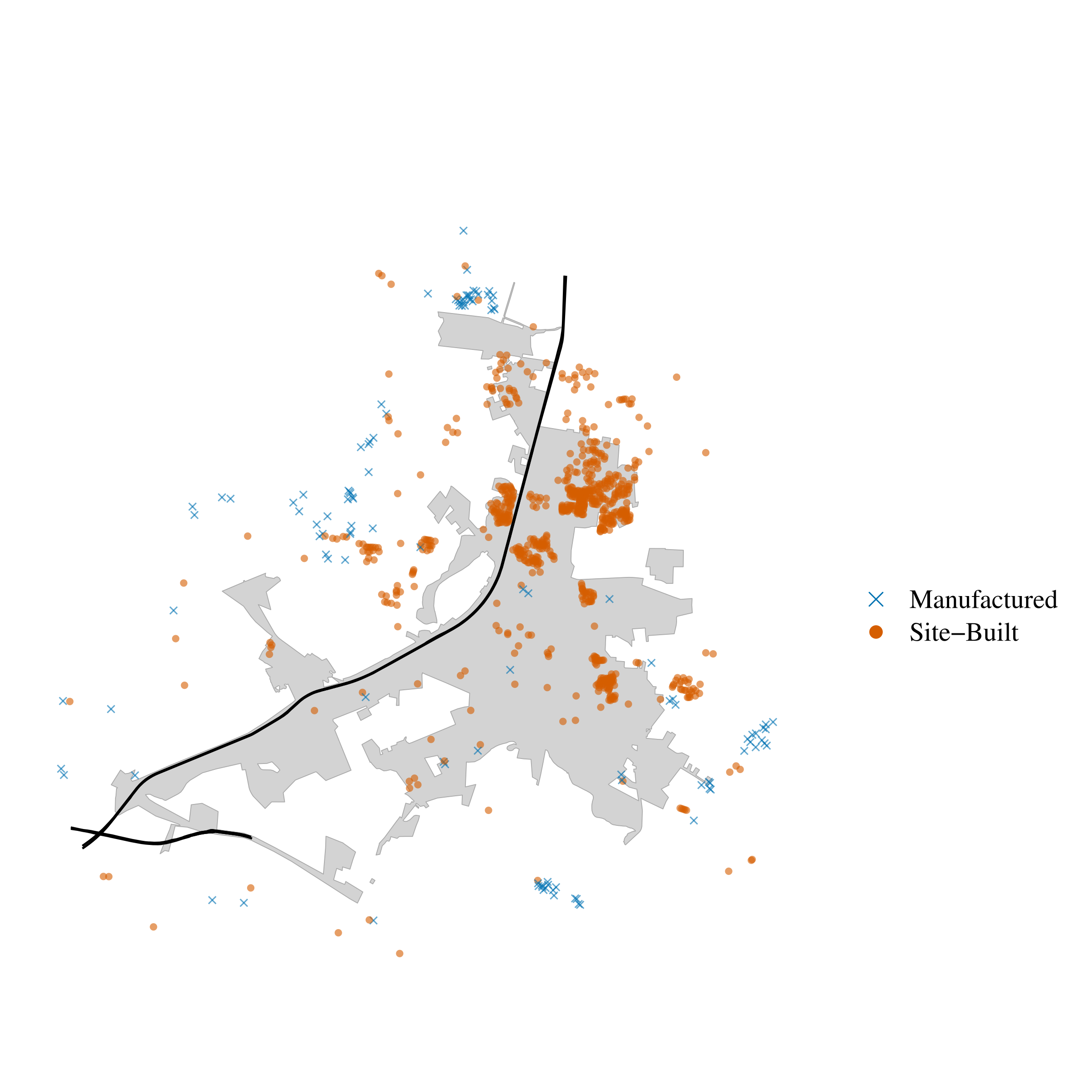
Local land use regulations shape not only how much housing is built but also its composition. I show that the mobile home share of detached homes quadruples at municipal boundaries, from roughly 2% to over 8%, suggesting that city regulations restrict mobile homes. Consistent with differential municipal regulation, the gap in price between manufactured and site-built homes is roughly $6,900 smaller inside cities. I develop a sufficient statistics framework to assess these distortions in the composition of the housing stock. The framework leverages a choice model over housing types where cities impose an implicit tax on mobile homes. I estimate the key statistics using a boundary difference-in-discontinuities design that compares outcomes across housing types and sides of the boundary. I then map these statistics to two structural parameters: the implicit regulatory tax and the elasticity of substitution between mobile and site-built homes. The model implies a high elasticity of substitution between the two types, so a modest regulatory tax reduces the share of mobile homes in cities by about 2.6 percentage points. Municipal land use regulations contribute to both the ruralization and small market share of mobile homes.
State Law, Local Finances, and Housing Markets: The Uneven Effects of Flat Fees
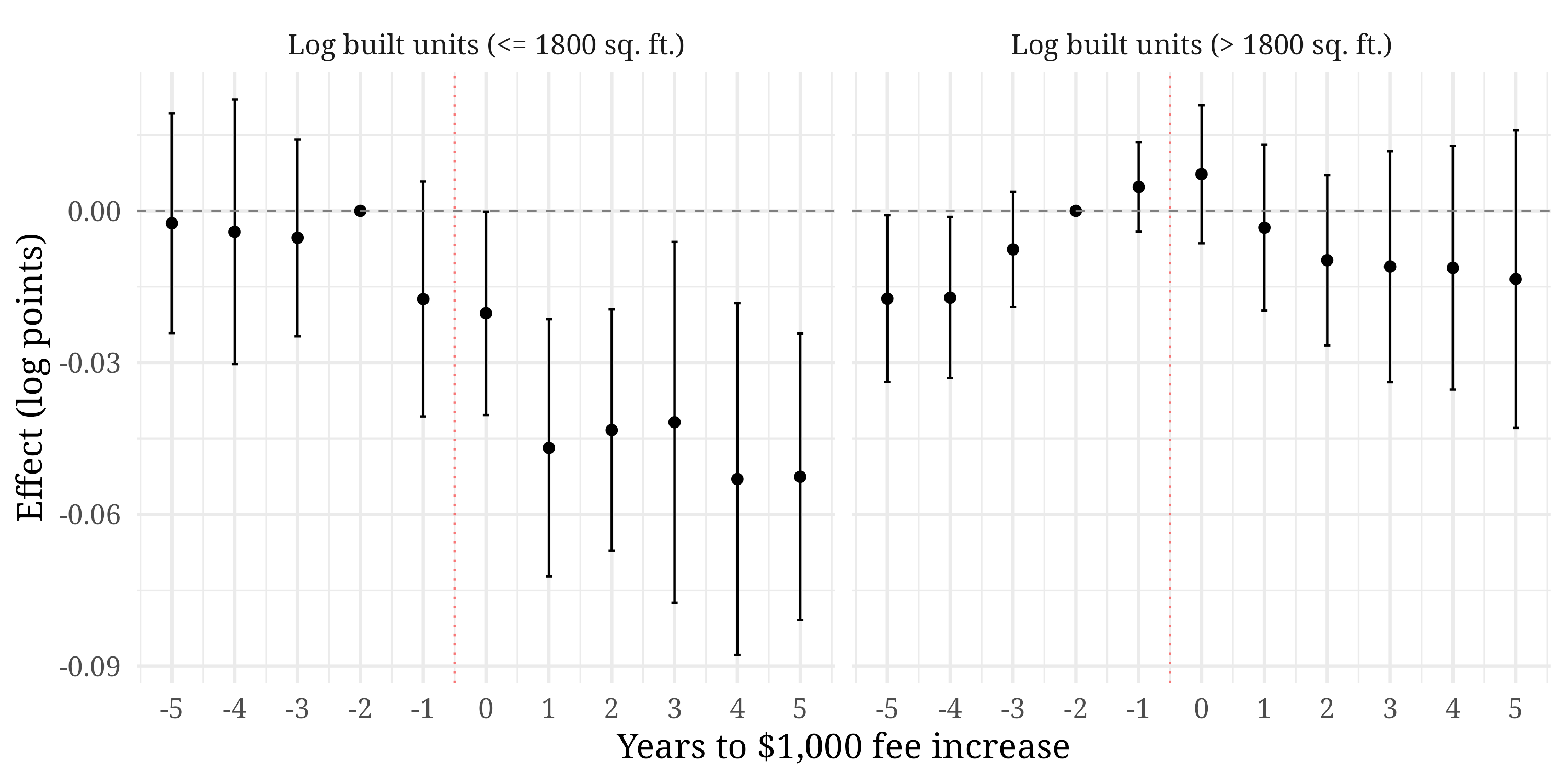
The average size of new single-family homes grew by over 40% between 1985 and 2014. I argue that this trend is explained by land use regulations which act as fixed costs for developers. Because small homes are relatively less profitable, increasing regulation differentially affects the development decision, increasing the average size of the remaining projects. Using variation in fixed costs from development impact fees, I confirm these predictions and find that fees alone can explain roughly 15% of the increase in average sizes over the period.
Impact Fees and the Composition of Local Government Spending
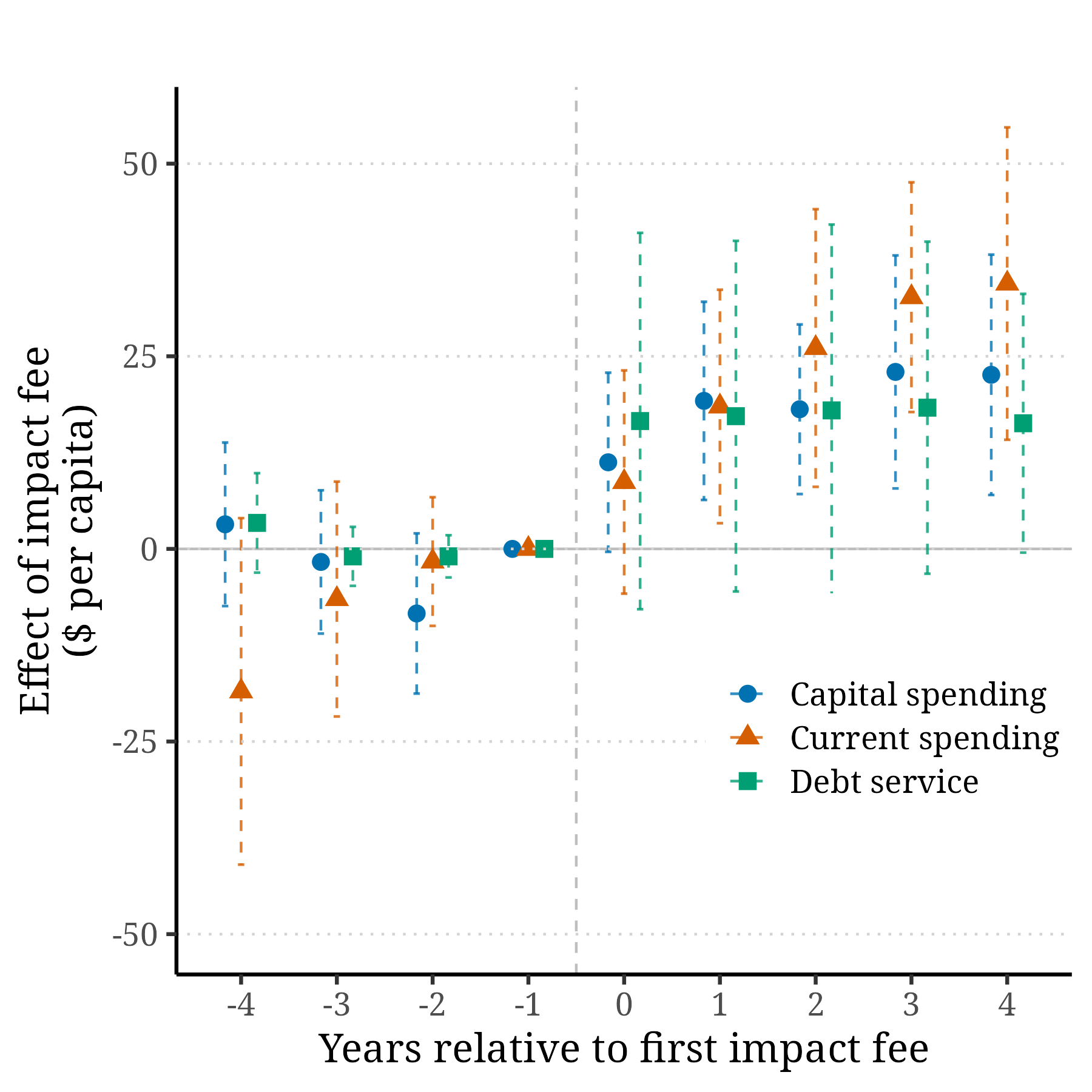
Impact fees are charges on new development earmarked for designated capital infrastructure. I study how their adoption affects local government spending using annual financial reports for 354 Florida jurisdictions from 1996 to 2019. Comparing spending across six categories within jurisdictions and over time, I find that capital spending and debt service in the designated category rise by nearly $3 for every $1 of new fee revenue, relative to other categories. Capital spending increases initially and declines toward baseline by year six, while debt service remains elevated. These patterns are consistent with borrowing against anticipated fee revenues. The estimates show that adoption of an earmarked revenue instrument changes spending composition.
Retailer Congestion and The Timing of Transfer Payments
We use granular geolocation data and multiple empirical strategies to document that congestion is a pervasive feature of brick-and-mortar retail. Retailers do not adjust prices to reduce congestion. Instead, they invest in extra capacity in order to meet demand during the busiest periods, furthering urban sprawl.

 Municipal Zoning and the Geography of Mobile Homes (Job Market Paper)